Today, Thursday, we decided to go on a popular cable-suspended tramway ride and hike a trail to waterfalls. First, we enjoyed the lodge’s breakfast of watermelon, scrambled eggs and a small “pancake” of ground cassava with cheese, served with pineapple juice and hot tea. Then we headed out under a gray sky to take a taxi to the tramway at 8:30 or so. We were their first customers and we had to wait while a worker was grinding or polishing a part of the metal tram car. It was a little unsettling to be the first riders after a “fix” that required someone wearing a welder’s helmet. The far-side tram operator rode with us as the tram car traversed high above the river canyon below. But everything went smoothly and reached the far side in about 3 minutes.
Tram car crossing the river valleyA diagram of the tramway, hiking trails and waterfalls
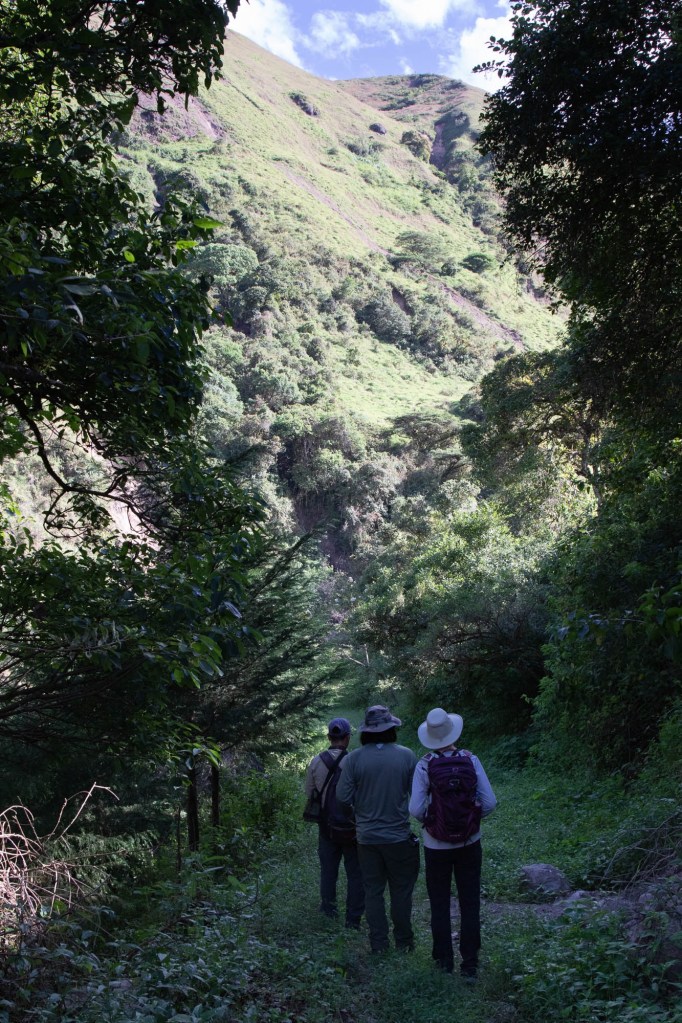
We started hiking downhill to the first waterfall. The temperature was in the sixties, very humid, but not raining. And we had the trail to ourselves. It was wide but fairly steep with steps. By the time we reached the third or fourth waterfall, I was quite sweaty and my glasses were continually steaming up. Nathan’s camera lens was steamed up too. So we decided to return to the top without seeing all 5 waterfalls. But we got some good exercise and saw some pretty falls. As we hiked back up, we met several hikers starting the journey down. At the tram station again, we watched the tram car go back and forth a few times while we rehydrated and cooled down. Then we took it back across the canyon. The operators had called our taxi driver already to come pick us up, so he arrived a few minutes later to take us back to town. The whole adventure took about 2 hours.
A section of the trail to the waterfallsNathan at one of the fallsSome of the vegetation along the path
In Mindo, we stopped at the bus terminal to buy tickets for tomorrow’s ride back to Quito. Then we went to a little restaurant for lunch. Nathan had chicken and rice and I ordered a caprese salad of tomatoes and cheese with basalmic vinegar. After lunch we headed back to the cabaña and relaxed on the porch. It began to rain not long afterwards and didn’t stop all afternoon and evening. We didn’t feel like walking to a restaurant in the rain, so we ended up eating protein bars to stave off the hunger pangs ‘til morning.
Wednesday started very early, about 4:45 a.m., because I had booked a birdwatching tour that would start before dawn. A birding guide, Sandy, and her driver David picked us up in her Chevy SUV in front of our lodge/cabañas at 5:20. Nathan and I were ready: him with a camera and me with my binoculars.
Our first stop was a place in a protected forest where the bird that I really wanted to see, the Andean Cock-of-the-Rock, displays every morning during breeding season. After a 30-minute walk uphill in the dark, over a stream crossed by a 2-log-wide bridge, we reached the lek, the display place, which remains in the same place every morning. It was noisy with spectacular displaying males, about 15 per Sandy’s estimate, and 1 female who gets to choose the male that appeals to her the most. Wow, what a show of crazy-looking red birds! We were mesmerized watching the males display in the trees, while they watched the female and each other. Whenever the female flew away, the males suddenly got quiet, but became animated and boisterous again when she returned. Sandy took a digiscoped photo with my phone of one of the males and the duller female.
A male Andean Cock-of-the-Rock at the lek
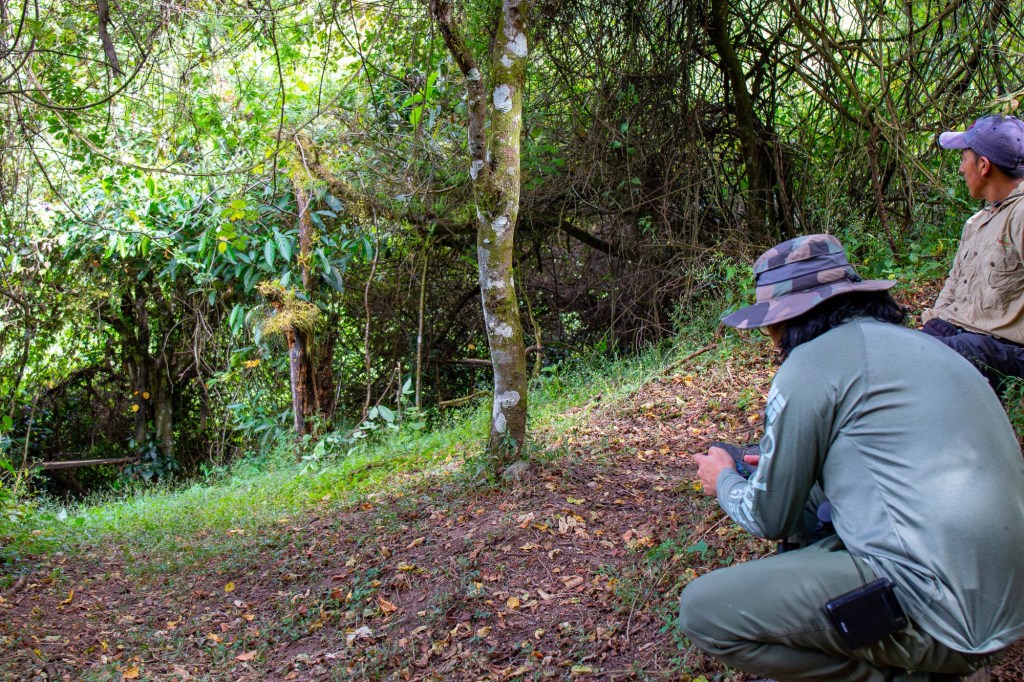
Two more groups of birdwatchers arrived while we were there, one French-speaking with their guide and a pair of Spanish speakers and their guide. We stayed for about 30 minutes, then hiked back toward the start, onto an open hilltop, in order to spot other types of birds. By this time, the sun was up, so seeing the trail and birds was much easier. Sandy used her expert listening and song recognition skills plus her scope to find many new species for us, including a pair of Golden-headed Quetzals, Swallow-tail Kites, Rufous Motmots, and several others. It was great!
Sandy finding birds after sunrise
Next, Sandy and David took us to a birding site called San Tadeo, where the owner keeps fruit and nectar feeders stocked to attract hummingbirds, tanagers, and other birds. The owner also provided coffee, tea, fresh fruit, granola, yogurt, toast and hard boiled eggs for our own breakfast while we watched the birds. Between bites, Sandy identified all the birds that were coming to the feeders, including many of the numerous hummingbird species in Ecuador. And the stop was located on a hill overlooking the town of Mindo, so we had a beautiful view. It was another super experience.
San Tadeo birding site overlooking Mindo
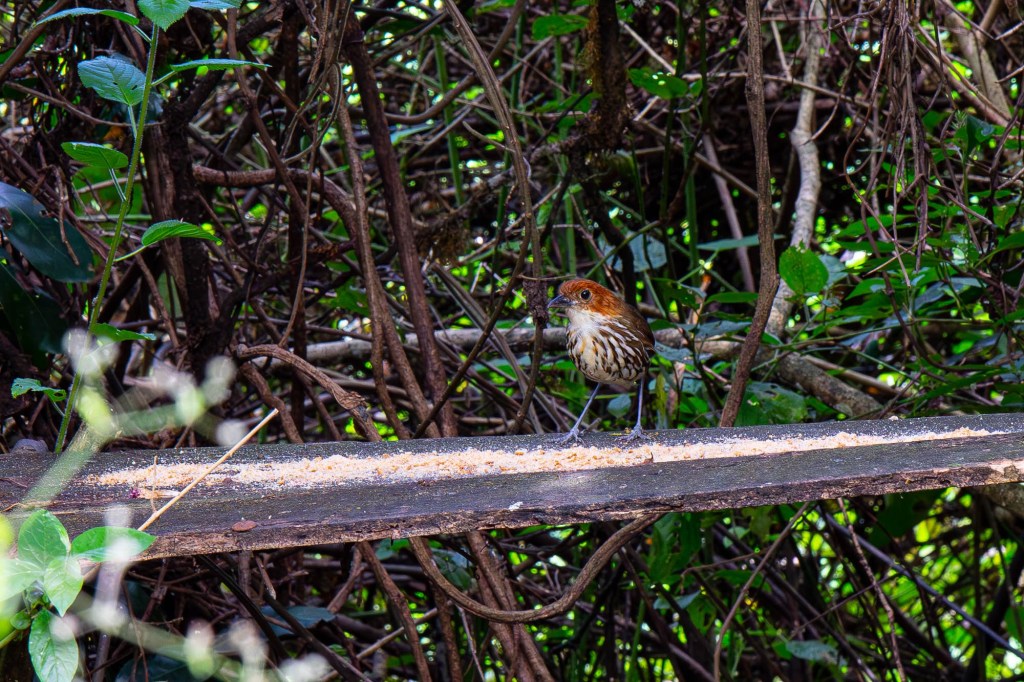
The final 90 minutes of the tour took us to another high location at which Sandy hoped to find toucans for us. We didn’t see those, but did see the interesting Barred Puffbird, vultures, a Common Potoo, Golden Olive Woodpecker and many other birds. We also met her son, who was guiding a group of British birdwatchers in that area. The tour ended back at our cabaña about 11 a.m. It had been an excellent birding experience.
We walked to a restaurant in Mindo for lunch of lentil soup, rice and fried chicken, and then returned to our cabaña’s porch to relax for the afternoon.
Nathan on one of Mindo’s streetsThe city park behind the Mindo signThe entrance to Cabañas Armonía, where we stayed
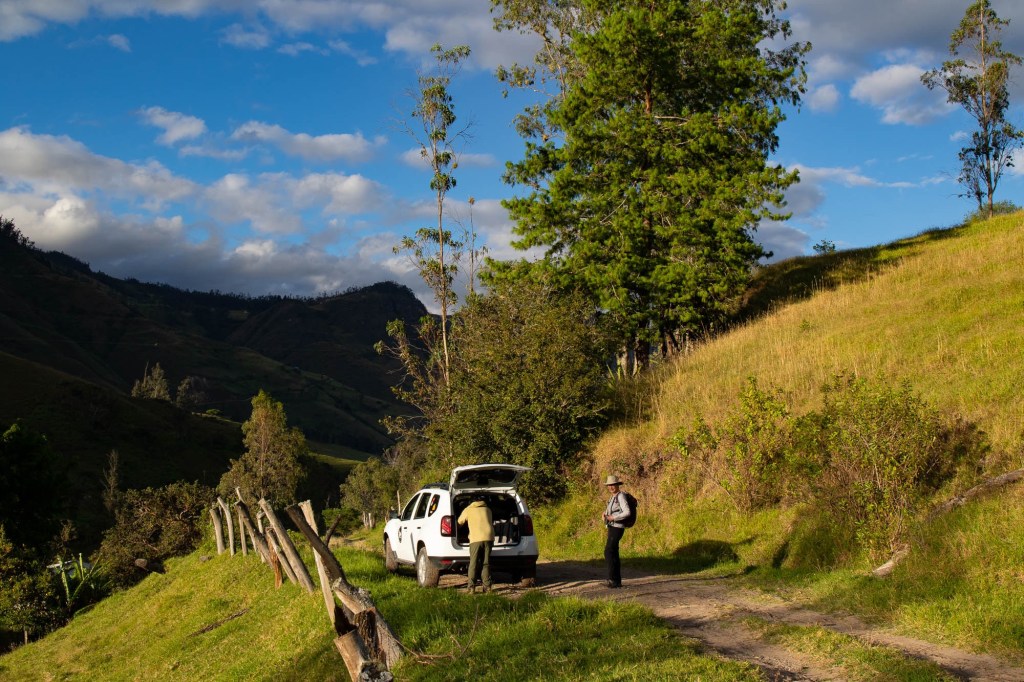
I had also signed up for a night walk, hoping to see some of the nocturnal creatures of the cloud forest. So after eating dinner in town, I waited outside the cabañas to be picked up at 7 p.m. for the walk. It was already dark by that time, since the sun sets about 6 p.m. Nathan sat out this tour. A young man driving his white Toyota pickup collected me and another pair of young tourists and drove us to the walk location, back on the same dirt road we had been birdwatching on earlier in the day. The young couple were Ecuadorians from Quito who spoke Spanish and English and the guide was a man of about 40 whose English was just ok, not great. We were given small flashlights and followed our guide on a hillside trail into the night.
During the 90-minute walk, we saw numerous species of very small frogs, millipedes, fruit-eating bats, a kinkajou, small scorpions with bioluminescent spots, and a huge forest cockroach. No snakes, which suited me fine. It was a misty, still night and when the bats flew by, we could feel the breeze they generated and hear their wingbeats. It was a fun experience but not as great as the morning birdwatching. When the driver took us back into town at about 9:15, to our lodgings, it was raining.
A beautifully sunny day dawned in Mindo about 6 a.m. after a good night’s sleep in which I was able to recover some of the sleep I lost the day before. It was a lovely morning to sit on the deck before breakfast to listen and look for birds in the garden. So that’s what I did.
Thick garden vegetation draws in birds in front of our cabin.
Breakfast was served starting at 7:30 in a large dining room in another building on the property. A group of 10 young people and their leaders, here on a missionary trip, were also there. Our meal began with a large glass of watermelon juice, tea, and a slice of perfectly ripe pineapple. Then they brought eggs, cooked to our order, and a chicken empanada each. The empanada is a filled pastry that’s deep fried to a lightly crunchy perfection. It was a very good meal.
We wanted to visit the Mariposario, or butterfly house, which Nathan recommended after going there on a previous visit. We decided to walk, which Nathan had also done previously, although most people take a taxi. So we started down the dirt road following a sign to the garden of butterflies. But after about 30 minutes of walking, spotting birds and butterflies along the way, Nathan realized we were on the wrong road. So we turned around and walked back into town. It had been a pleasant walk, over a rushing river at one point, even though it was the wrong way.
Nathan and I walking out of town.The river we crossed along the way.
In town, we found a taxi stand and asked an older taxi driver to take us to the butterfly house. He only spoke Spanish, which gave me the opportunity to practice the Spanish I had been learning for the last 4 years. During the 10 minute drive we had a really interesting conversation in which he talked about the transformation Mindo had undergone over the last 30 years, from overgrazed farming area suffering drought and sick cattle, to a reforested preserve focused on ecotourism and which had greatly benefited both the residents and the native birds and animals. I was so happy to be able to understand and talk to him in Spanish! It was very gratifying and educational. And the taxi fare was only $3.
The butterfly house was really nice too. We spent about 2 hours there, walking through the inside and outdoor butterfly enclosures, relaxing on benches next to the path, and feeding some koi fish in a few ponds. The same taxi driver returned to take us back to Mindo, which we had asked him to do. On the return trip, we talked about the difficulties COVID had posed for his family making a living due to the government’s policy that prohibited work and even local travel around town. I’m sure he was talking slower than normal so I could follow what he said, and I know my Spanish wasn’t great. But it was so fun to be able to have the conversations.
The Mariposario, or Butterfly House
We ate savory crepes for lunch in an open air restaurant when we got back to town. Mine was chicken and mushroom, with a delicious passion fruit shake (batido in Spanish) to go with. After lunch, we walked to El Quetzal, a lodge and chocolate tour host. We went on a 1-hour tour of how they make specialty Ecuadorian chocolate. It was interesting and we got to try a few samples too.
Nathan, a cocoa pod, dried cocoa beans and other chocolate products
We finished the afternoon in town by treating ourselves to frozen yogurt in one of the shops. As we walked back to Cabañas Armonía around 3:15, it thundered distantly and we felt a few raindrops. A good time to return to our cabin.
Why did I book a flight to Quito that required an 8-hour layover in Mexico City? I must have been crazy. My Sunday morning AeroMexico flight required a 5:45 a.m. airport shuttle pickup, 5 hours on the plane, then lots and lots of waiting in the Mexico City airport, where my backpack thermometer said it never got below 80 degrees. Then a 12:25 a.m. flight to Quito and of course I never really slept even though I tried really hard. The only redeeming experiences of the flight were the sight of lightning flashing in thunder clouds a distance away just before the sun came up over Ecuador, and the green mountainous landscape of Quito with two nearby silhouetted volcanoes as the plane landed at sunrise.
By the time the plane reached Quito, I had been awake more than 24 hours and was rather punchy. But things got better quickly. It’s a beautiful, small airport at Quito, I had a fast transit through immigration and customs, then was treated with a clear sunny morning with a view of Cotopaxi volcano and a hearty breakfast at the adjacent Quito Airport Center while I awaited Nathan’s arrival from Cuenca an hour after my landing.
Cotopaxi volcano (on the right) from Quito airportLots of meat in this hearty breakfast
Once Nathan met me at the airport, we took a taxi through Monday morning rush hour traffic to the National Basilica of Quito in the historic downtown. It held some beautiful stained glass and a vista over part of the city.
Since I was lugging my suitcase and didn’t have lots of energy, we didn’t stay long at the basilica. Long enough to walk around the inside and outer plaza, buy some bottled water to enjoy in the sunshine, and for me to experience a public restroom in which I had to pay the male attendant 25 centavos to be able to use it and receive some toilet paper as part of the deal. It was a very clean restroom and entirely worth the price.
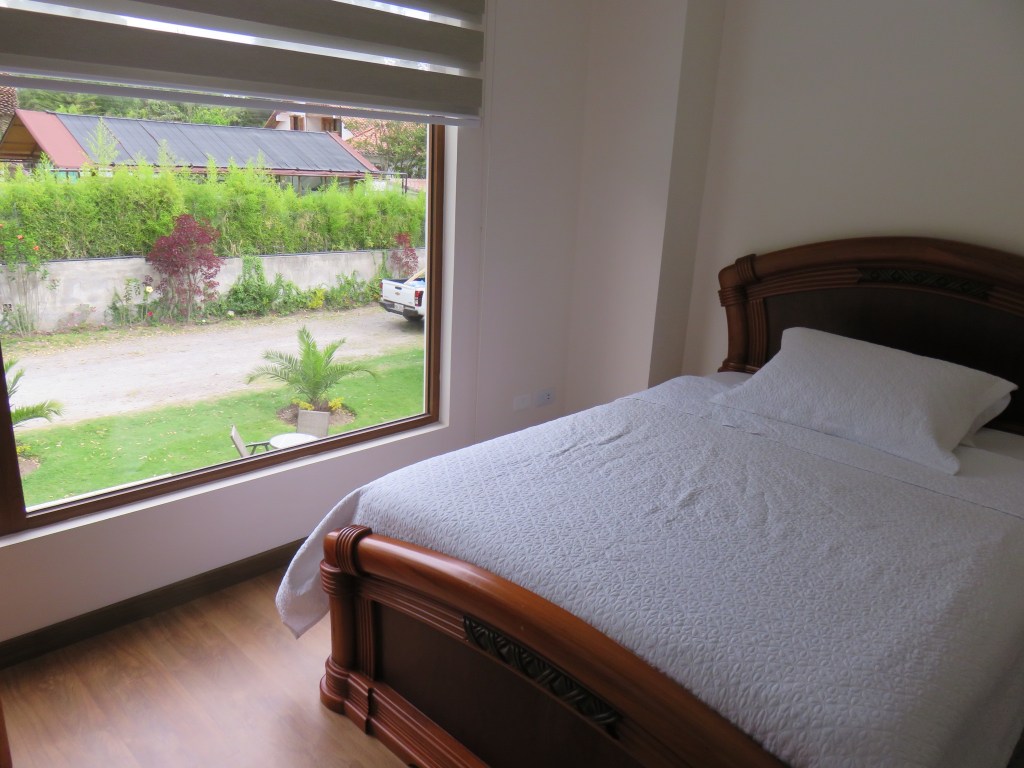
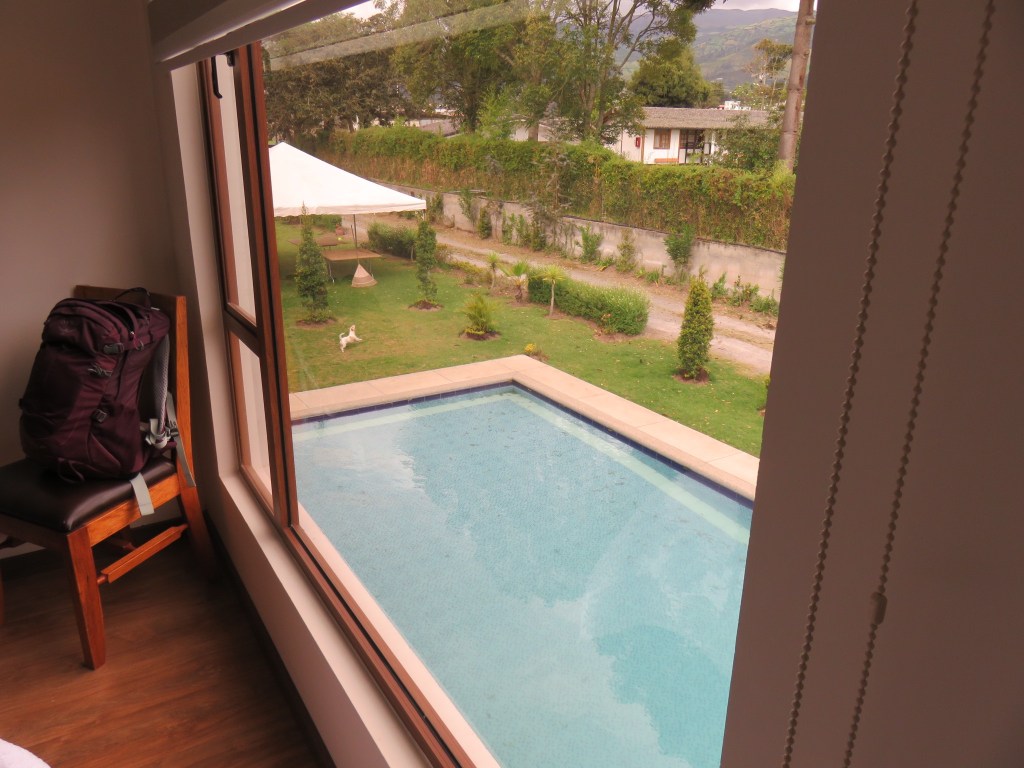
As I was running out of steam, we caught a taxi to the Ofelia bus station, from where the buses to Mindo leave. The 2-hour bus ride to the cloud forest town cost only $3.60 total for the two of us and left promptly at 11 a.m. We arrived a little after 1 and found our lodging for the next 4 nights, the Cabañas Armonía in the heart of Mindo. Ours is a little cabin with a bathroom, complete with hot shower, 2 beds, and a little deck with hammock and chairs overlooking a lush garden of orchids and other tropical plants.
After an orientation walk around town, and lunch of cerviche and rice with shrimp in a little restaurant, I took a short nap in the cabin. Then we returned to town to book a birding tour for later in the stay and buy a couple bottles of water. We closed out the evening on the cabin’s deck , listening to birds, cicadas, and crickets as the sun set not long after 6 p.m.
Thursday was the day for visiting the park I had wanted to see for the longest time, Steptoe Butte. It was an overcast morning in Pullman. The bistro downstairs in the Marriott Courtyard that was supposed to serve breakfast wasn’t open because their morning staff hadn’t shown up for work. So Dave and I drove to the nearest McDonalds, which was new and had very friendly staff, for a fast food breakfast. Then we returned to the hotel and checked out.
We drove out of Pullman and through more rolling fields of very green winter wheat to reach Steptoe Butte, which towers above the other hills. By the time we got there, the sky was mostly blue and it was another beautiful day in the Palouse.
The view from the top of the butte didn’t disappoint. We had the summit nearly to ourselves and the view was quite spectacular. We saw a raven enjoying the wind that was blowing upslope by doing several barrel rolls while croaking, plus a pair of Western Kingbirds and a Black-headed Grosbeak. Many wildflowers were blooming too.
Only my car at the top and several views of the fields down below.
After the butte, next was Steptoe Battlefield State Park, which was about 30 minutes away and tiny in comparison to all the previous parks during the trip. It consisted of only a monument to the Army soldiers lost in a battle with Indians in 1858, plus a couple of picnic tables, one of which was in the shade of an old horse chestnut tree. We ate our lunch under the tree while enjoying the birdsongs in the park.
Even the sign to Steptoe Battlefield park was a little disappointing.
The final state park of this trip was actually a trailhead near Cheney. The Columbia Plateau Trail is on an old railroad grade and stretches for more than 30 miles. We walked only a very short distance along the paved path.
I had to go through a barbed wire fence to get to this sign.
It was time to return home. We had been able to visit 7 state parks on this enjoyable trip, during which we experienced perfect weather and fresh, green landscapes. We got on I-90 for the 4+ hour drive back home from our short visit to the southeast corner of the state.